Atlas Copco Air Compressors


How to Size an Air Compressor for Your Plant: CFM, Pressure and kW Explained
Buy a compressor that is too small and it will short-cycle and starve your tools; buy one that is too big and you waste energy and money every hour it runs. Correct sizing is the single biggest factor in a compressed-air system that is both reliable and cheap to run. Here is how to size an air compressor in four practical steps.
Step 1: Add up your air demand (flow)
Flow is measured in CFM (cubic feet per minute) or l/s (litres per second; 1 CFM ≈ 0.47 l/s). List every tool and machine that runs on compressed air, note the air consumption of each, and add up everything that can run at the same time. Do not simply total every tool in the building — base it on realistic simultaneous use.
If you don’t have consumption figures, an air audit or a data-logger on your existing system is the most accurate way to capture real demand across a shift.
Step 2: Determine your required pressure
Pressure is measured in bar or psi (1 bar ≈ 14.5 psi). Find the highest pressure any critical tool needs, then account for pressure drop across piping, filters and dryers — typically 0.5–1 bar. Most industrial plants run at 7–10 bar; some processes need 13 bar or more. Do not over-pressurise the whole plant for one high-pressure tool: every extra 1 bar of pressure adds roughly 6–7% to energy use.
Step 3: Add a sensible safety margin
Add around 20–30% to your calculated flow to cover future growth, system leaks and demand peaks. Leaks alone waste 20–30% of output in many older plants, so a margin is realistic rather than generous. Don’t go far beyond that, though — a heavily oversized fixed-speed compressor spends its life loading and unloading, which wastes energy.
Step 4: Match flow to motor power (kW)
As a rough rule of thumb for rotary screw compressors, expect about 3.5–4.5 CFM per kW at 7 bar (higher pressure gives less flow per kW). So a plant needing ~300 CFM usually lands on a 55–75 kW machine. Use this only to sanity-check — always confirm against the manufacturer’s published FAD (Free Air Delivery) at your working pressure.
Fixed-speed or variable-speed?
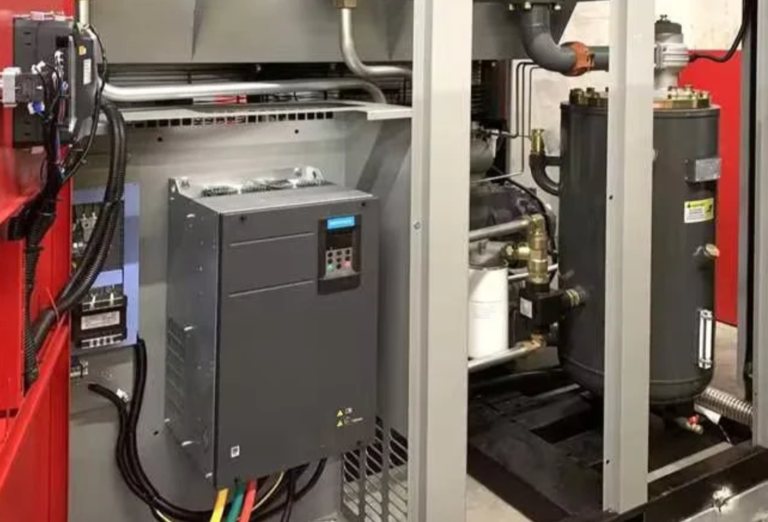
If your air demand is steady around the clock, a fixed-speed compressor is simple and economical. If demand swings between shifts or across the day — which is true of most plants — a variable-speed (VSD) machine matches motor speed to real demand and commonly cuts energy use by 30–50%. See our guide to variable speed drive compressors to decide.
A worked example
A metal-fabrication workshop runs plasma cutters, grinders and pneumatic tools totalling ~210 CFM simultaneously at 8 bar. Add a 25% margin → ~260 CFM required. At roughly 4 CFM/kW that points to a 55–75 kW compressor. Because the shop only runs two shifts with variable load, a variable-speed unit is the better long-term choice.
Recommended models by size
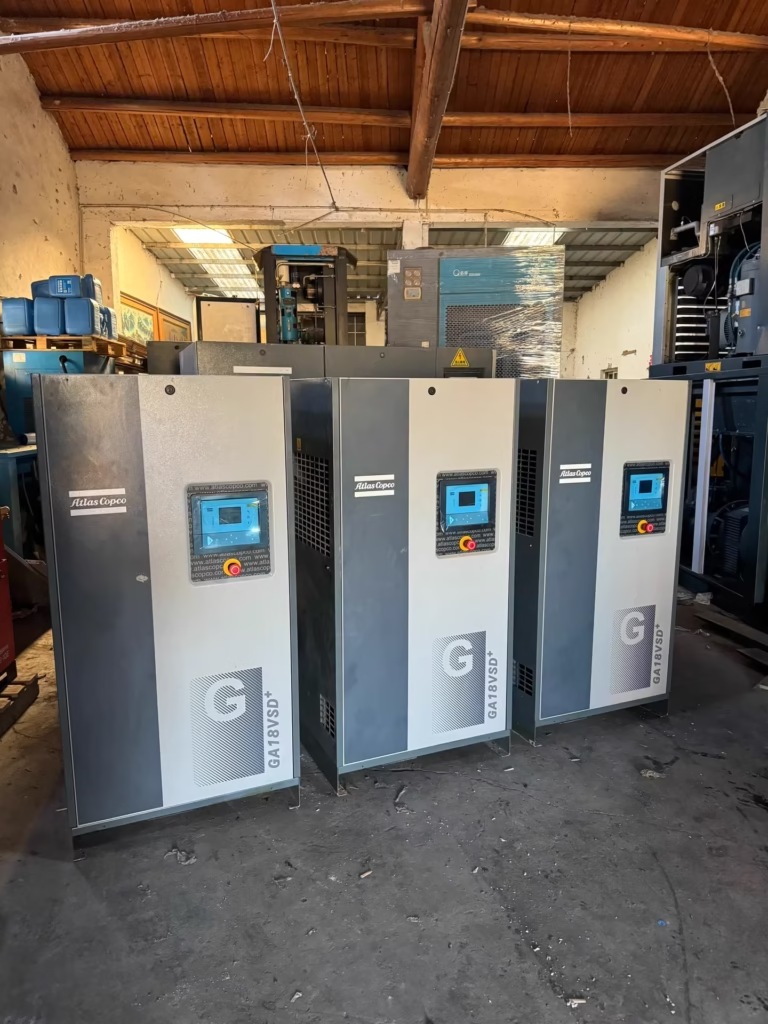
- Small workshops (up to ~60 CFM): GA11, GA15
- Mid-size plants (~60–130 CFM): GA22, GA30, GA37
- Large / central air stations (130–350+ CFM): GA55, GA75, variable-speed GA75 VSD
Not sure which size fits? Send us your tools, running hours and working pressure and CATC will size the right Atlas Copco machine for you — request a quote below.